

Learn web scraping automation using n8n with step-by-step instructions. Extract website data, automate workflows, clean results, and save information securely.
Table of Contents
Web Scraping Automation Using n8n: A Complete Step-by-Step Guide for 2026
Introduction
The net includes an substantial amount of data. Businesses, marketers, researchers, builders, and content material creators often want statistics from websites to apprehend markets, reveal adjustments, studies competition, and make better choices. However, gathering this facts manually can grow to be a repetitive and time-eating venture.

Imagine checking a couple of websites every morning to find new product listings, acquire article titles, monitor public bulletins, or track changes in publicly to be had records. You might need to open every internet site, find the applicable facts, replica it, organize it, and store it somewhere useful. Repeating this method each day isn’t an green way to work.
This is where Web Scraping Automation using n8n will become treasured.
N8n is a workflow automation platform that lets in you to connect distinct applications and automate records-related tasks. With its HTTP Request and HTML nodes, you can retrieve webpage content material, extract decided on information, technique the results, and ship them to gear which includes spreadsheets, databases, or notification systems.
The excellent element is that you may build many fundamental scraping workflows with out writing a whole scraping software.
In this guide, you will find out how internet site scraping works, which n8n nodes are beneficial, a way to construct a practical workflow, the way to extract information the use of CSS selectors, and a way to cope with pagination, mistakes, dynamic websites, and statistics garage.
You may even examine vital safety and responsible records series practices before putting an automated workflow into regular use.
What Is Web Scraping?

Web scraping is the procedure of collecting precise facts from webpages and converting it right into a structured layout that can be processed or saved.
A web site is commonly added as HTML, which describes its shape. HTML incorporates elements along with headings, paragraphs, hyperlinks, photographs, tables, and different content.
For instance, take into account a public product catalogue. Each product list may include:
- Product name
- Displayed fee
- Product description
- Product page URL
- Availability facts
Instead of copying those details manually, a scraper can retrieve the webpage and extract decided on fields.
The extracted statistics can then be stored in a spreadsheet or database for in addition analysis.
Web scraping is beneficial for several purposes:
- Market research: Collect publicly to be had information to apprehend industry traits.
- Content studies: Monitor new articles, public reports, and announcements.
- Product monitoring: Track publicly displayed product facts where authorised.
- Lead studies: Organize enterprise information this is lawfully to be had on your meant use.
- Research projects: Gather based information from assets that allow automatic get entry to.
However, amassing information does no longer mechanically provide you with permission to republish it or use it commercially. Always review the internet site’s phrases, relevant privateness necessities, and restrictions earlier than amassing or reusing statistics.
What Is n8n and Why Use It for Web Scraping?
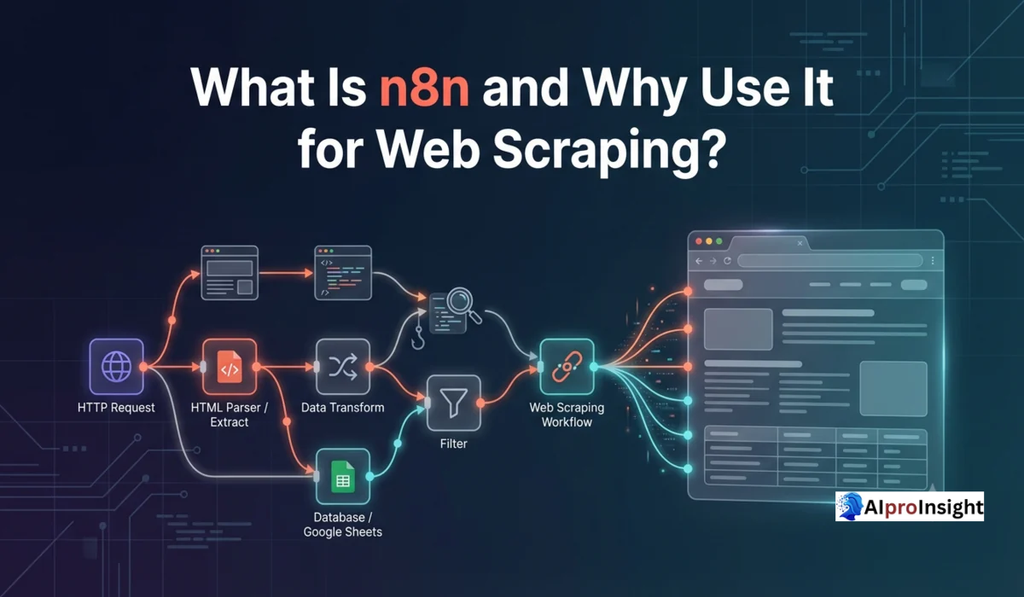
N8n is a workflow automation platform that connects applications, APIs, and information-processing steps through a visual workflow editor.
A workflow consists of nodes. Each node plays a particular challenge, which includes starting a system, retrieving information, transforming records, checking a condition, or sending a notification.
For Web Scraping Automation using n8n, the most crucial components are the HTTP Request node and the HTML node.
The HTTP Request node retrieves website content material or communicates with an API. The HTML node extracts selected records from HTML using CSS selectors.
After extraction, you could join different nodes to easy, organize, keep, or distribute the collected statistics.
Why Choose n8n?
Here are some sensible benefits:
Visual workflow building: You can apprehend the complete process via related nodes rather than coping with a big standalone script.
Application connectivity: n8n can join the gathered information to supported spreadsheets, databases, messaging structures, and other services.
Scheduled automation: You can run a workflow at a deliberate time in place of manually repeating the collection manner.
Data processing: You can filter, transform, validate, and organize information earlier than saving it.
Flexible API connections: The HTTP Request node can speak with many REST APIs, which includes services with out devoted n8n nodes.
Workflow monitoring: You can look into executions and discover in which a technique failed.
N8n is mainly beneficial when facts collection is handiest one a part of a larger commercial enterprise process. Instead of virtually downloading records, you may build a entire workflow round it.
How Web Scraping Automation Using n8n Works
Before building a workflow, understand the general system.
A basic scraping workflow follows this collection:
- A trigger begins the workflow.
- An HTTP Request node retrieves the web site.
- The HTML node extracts the specified statistics.
- Data-processing nodes clean and prepare the consequences.
- A destination node shops or sends the gathered statistics.
- Error-dealing with steps help identify unsuccessful requests.
For instance, think you want to accumulate article titles and links from a public website that allows automatic get admission to.
Your workflow may want to retrieve the web page, extract the item titles and corresponding URLs, cast off empty outcomes, and shop the statistics in Google Sheets.
This is the primary shape behind many beneficial scraping tasks.
Requirements Before Building Your First Scraper
Before starting Web Scraping Automation using n8n, put together the subsequent:
1. An n8n account or installation
You can use n8n Cloud or a self-hosted set up. Choose the option that suits your technical requirements and expected workflow quantity.
2. A permitted target website
Select a website that lets in the sort and frequency of computerized get right of entry to you intend to carry out. Review its terms and relevant crawling steerage.
3. A clear data collection objective
Decide exactly what you need. For example, you may need article titles, book dates, and hyperlinks as opposed to downloading every element on a web site.
4. Basic HTML understanding
You do now not need to become a web developer, however knowledge HTML factors and CSS selectors will make extraction a great deal easier.
5. A destination for collected data
You can use Google Sheets, Airtable, a database, or some other supported vacation spot depending in your necessities.
Start with a small, easy undertaking. It is less complicated to apprehend and troubleshoot a workflow that extracts three fields from one approved page than a complicated crawler that visits masses of pages.
Step-by means of-Step: Build a Web Scraping Workflow in n8n
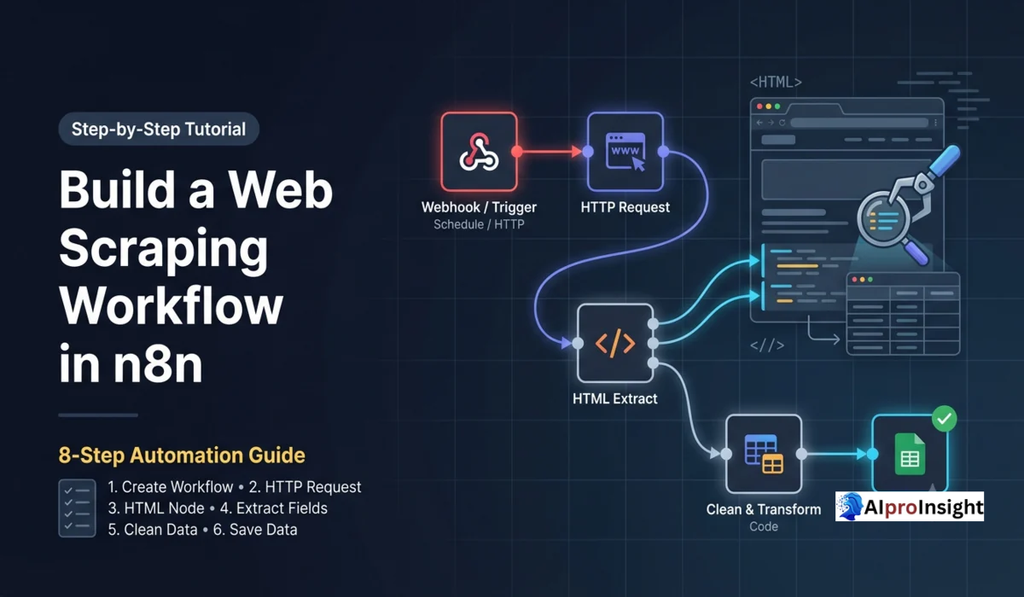
Now permit’s construct a primary example the use of a public website that lets in automated get right of entry to. The aim is to retrieve HTML, extract decided on records, and put together it for storage.
Step 1: Create a New Workflow
Sign in for your n8n workspace and create a brand new workflow.
Give it a descriptive name, which includes:
Public Website Data Collection
A clear call turns into beneficial when you begin dealing with multiple workflows.
For the primary test, use a Manual Trigger node if it’s far to be had on your model. This allows you to execute the workflow your self at the same time as configuring each step.
Later, you can replace or supplement the guide trigger with a Schedule Trigger.
Step 2: Add the HTTP Request Node
Add an HTTP Request node to the workflow and connect it in your cause.
This node retrieves information from a particular URL.
Configure the following settings:
- Method: GET
- URL: Enter the authorized webpage URL.
- Response Format: Text, in which available, so the back HTML can be handed to the extraction step.
- Authentication: None handiest if the web page is publicly reachable and does no longer require authentication.
The actual response-format options may additionally range via n8n model.
Execute the node and look at the output.
If the request succeeds, you must receive the web site’s HTML reaction. It can also contain headings, hyperlinks, paragraphs, metadata, and other web page factors.
If the output incorporates an errors message, look at the reaction repute and request settings before persevering with.
Step 3: Understand the HTML Structure
This is an important step in Web Scraping Automation using n8n because the extraction process depends on the structure of the webpage.
Open the permitted webpage in your browser and inspect the element containing the information you want to collect.
For example, a page might contain an article heading structured like this:
<h2 class="article-title">
  Understanding Workflow Automation
</h2>
The heading uses an HTML h2 element and a CSS class named article-title.
A CSS selector can identify this element:
h2.article-titleIf you want to extract every matching article heading, the selector helps identify those elements.
The important point is that CSS selectors depend on the actual HTML structure. A selector that works on one website may not work on another.
Step 4: Add the HTML Node
In cutting-edge n8n variations, use the HTML node for extracting content material from HTML-formatted statistics. Older tutorials may additionally refer to the HTML Extract node, so the interface or terminology can also fluctuate.
Connect the HTML node after the HTTP Request node.
Configure the HTML extraction operation and select the source records back by way of your HTTP Request node.
For example, if the HTTP Request node shops the reaction in a field named facts, pick out that field because the enter property.
Then add an extraction fee:
- Key: article_title
- CSS Selector: h2.Article-name
- Return Value: Text
- Return Array: Enabled in case you need all matching headings
The precise fields to be had rely on the operation and n8n model.
Execute the HTML node and inspect the output.
If the selector matches the web page shape, you have to acquire the extracted headings as textual content.
You can repeat this procedure for other fields, inclusive of article links, publication dates, or descriptions.
Step 5: Extract Multiple Fields
A useful scraper commonly wishes multiple field.
For instance, a content studies workflow may collect:
- Article title
- Article URL
- Publication date
- Category
Add the relevant extraction values the usage of selectors based totally at the real HTML.
For a hypothetical article card, the HTML may appear like this:
<article class=”publish-card”>
<h2 class=”article-name”>
Understanding Workflow Automation
</h2>
<a class=”article-link” href=”/workflow-manual”>
Read Article
</a>
</article>
Possible CSS selectors encompass:
.Submit-card h2.Article-identify
.Publish-card a.Article-link
For the name, choose the Text go back fee. For the link, choose the right characteristic, along with href, if the HTML node offers attribute extraction.
When amassing more than one data, configure the extraction to go back arrays in which appropriate.
Always check out the output. A selector can also go back empty values if the internet site modifications its layout or uses specific elegance names.
Step 6: Clean and Organize the Extracted Data
Raw web site records isn’t always usually geared up to be used.
It may additionally comprise greater whitespace, empty fields, reproduction facts, or incomplete URLs.
Add an Edit Fields node to choose and rename the residences you need to keep.
For instance:
| Original field | Organized field |
|---|---|
| article_title | Title |
| article_link | URL |
| publication_date | Published Date |
You can also use IF or Filter nodes to remove records that do not meet your requirements.
For example, you might exclude records where the title is empty or the article URL is missing.
If you need more advanced transformations, the Code node can help process values. Use it only when standard nodes and expressions are not sufficient.
Step 7: Save the Data
Once the extracted information is clean, connect a destination node.
For example, you can connect Google Sheets if you want to maintain a spreadsheet of collected records.
A possible spreadsheet structure is:
| Title | URL | Published Date |
|---|---|---|
| Article Example One | Example URL | Date |
| Article Example Two | Example URL | Date |
Map the fields from the previous node to the matching spreadsheet columns.
Before running the workflow on a large set of records, test it with a small sample.
Also consider duplicate prevention. If the workflow runs every day, the same article may appear repeatedly. You can compare the URL or another stable identifier with existing records before inserting a new row.
Step 8: Test the Complete Workflow
Run the workflow from starting to quit.
Check each node:
- Did the trigger begin efficaciously?
- Did the HTTP Request node retrieve the anticipated HTML?
- Did the HTML node extract the suitable fields?
- Did the cleaning step dispose of undesirable values?
- Did the destination spot get hold of the right records?
If a area is missing, go back to the HTML output and check out the selector.
Do no longer assume that a a hit HTTP response way the extraction is accurate. The website may also have returned a different layout, an get entry to-denied web page, or a JavaScript-generated shell rather than the content material you predicted.
Once the workflow produces dependable results, you could move on to scheduling and greater advanced functions.
How to Schedule Web Scraping Automation Using n8n
One of the most important blessings of automation is that you do no longer want to begin the system manually on every occasion.
N8n provides a Schedule Trigger which can begin a workflow at configured intervals.
For instance, you would possibly need to accumulate permitted public statistics:
- Every morning
- Once every few hours
- On selected days
- At a particular time every week
Add a Schedule Trigger to the start of the workflow and configure the c language that suits your use case.
However, do no longer schedule requests extra frequently than important. Respect the website’s phrases, crawling steering, price limits, and any restrictions on automatic access.
For instance, if a public web page modifications handiest once an afternoon, repeatedly checking it each minute is senseless.
A realistic agenda reduces resource intake and makes the workflow less difficult to maintain.
How to Handle Pagination in n8n
Many websites display data throughout multiple pages.
For instance, a public directory may display 20 entries on every page. If you need to collect more facts, you could want to retrieve additional pages.
This is known as pagination.
Common pagination styles consist of:
Page-wide variety pagination: The URL or question parameters comprise a web page quantity.
Offset pagination: The request specifies what number of data to bypass before returning the following batch.
Next-page hyperlinks: The reaction contains a URL pointing to the following page.
Cursor pagination: The carrier affords a continuation token for retrieving the subsequent batch.
The accurate approach depends at the internet site or API.
When using an API, the HTTP Request node affords pagination alternatives for supported request styles. For everyday HTML pages, you may need to build a managed loop that follows permitted subsequent-web page hyperlinks.
For Web Scraping Automation using n8n, pagination have to constantly include a preventing circumstance.
For instance:
- Retrieve the primary web page.
- Extract the information.
- Check whether a accepted next-page link exists.
- Continue most effective if some other page is available.
- Stop while there are no more pages or the configured restriction is reached.
Set a most range of pages or records so that an unexpected loop does no longer preserve indefinitely.
Static Websites vs. JavaScript-Rendered Websites
Not every website supplies its content within the same way.
Understanding this difference can keep big troubleshooting time.
Static or Server-Rendered Websites
Some web sites ship the required content material directly in the initial HTML response.
In those instances, the HTTP Request node can retrieve the HTML, and the HTML node can extract the relevant facts.
This is typically the most effective approach for a simple n8n scraping workflow.
JavaScript-Rendered Websites
Other web sites load their principal content material the usage of JavaScript after the initial web page is brought.
When this takes place, a everyday HTTP request may also go back only an HTML shell without the records you want.
The HTML node cannot extract content that isn’t present inside the reaction it gets.
You have some alternatives:
- Check whether the internet site gives an professional API.
- Determine whether or not a approved public records endpoint gives the desired facts.
- Use a licensed browser-rendering provider where suitable.
- Consider a appropriate browser automation answer in case you control the surroundings and have permission.
Do now not count on that each internet site can be scraped the use of only an HTTP Request node.
Also, do no longer try to bypass login regulations, CAPTCHAs, access controls, or different technical protections without authorization.
Practical Use Cases of Web Scraping Automation Using n8n
Once you understand the basic workflow, you can adapt it to numerous useful projects.
1. Content Research Automation
Content creators and advertising and marketing groups can gather authorized public facts together with article titles, booklet dates, and source links.
This statistics can help prepare research topics and pick out topics well worth investigating.
For example, a workflow should acquire new articles from selected public sources and save their titles and URLs in a studies spreadsheet.
Always recognize copyright whilst using the collected fabric. Collecting a name or link does no longer give you permission to breed a whole article.
2. Public Product Information Monitoring
Businesses may also want to display publicly displayed product records on websites in which automatic get entry to is authorized.
A workflow can accumulate selected fields and evaluate them with previously stored values.
If a displayed cost changes, an IF node can trigger a notification.
Do now not use scraping to pass access restrictions or violate a internet site’s terms. Prefer an reputable product or partner API while available.
3. Job Listing Research
Researchers and job seekers may also need to prepare publicly to be had activity listings.
Where permitted, a workflow ought to collect activity titles, business enterprise names, place details, and listing URLs from a supply that lets in automatic get right of entry to.
The consequences may be stored in a spreadsheet for less complicated assessment.
Avoid gathering non-public applicant facts or the usage of the workflow to pass a platform’s get admission to regulations.
4. Competitor Content Monitoring
Marketing teams can use authorized public information to display competition’ published articles, product announcements, or enterprise updates.
For instance, a workflow may test decided on public pages and notify a group while a new article seems.
This enables teams organize studies without time and again beginning each website manually.
5. Research and Data Collection
Students, analysts, and researchers may also need dependent statistics from public datasets or web sites.
An automated workflow can acquire accredited fields, normalize the values, and shop them in a database for in addition evaluation.
Always take a look at whether or not the supply allows automatic series and whether the meant studies use creates privateness or licensing worries.
Common Problems in n8n Web Scraping and How to Fix Them
Even a well configured workflow can fail. Here are common troubles and realistic approaches to troubleshoot them.
Problem 1: HTTP Request Returns an Error
Possible motives consist of an incorrect URL, unavailable server, unsupported request approach, or get admission to restrictions.
Solution: Verify the endpoint, check the reaction reputation code, and review the internet site’s documentation and get entry to regulations.
Problem 2: HTML Node Returns Empty Results
This usually happens when the CSS selector does now not fit the page shape or the anticipated content material is missing from the returned HTML.
Solution: Inspect the raw reaction, verify the detail and class call, and check a easier selector before adding more complex regulations.
Problem 3: Only Some Records Are Extracted
The selector may match handiest one element, or the webpage can also load extra statistics through pagination or JavaScript.
Solution: Check whether the extraction is configured to go back an array, inspect the HTML shape, and identify whether extra pages or a supported facts endpoint are required.
Problem 4: The Website Changes Its Layout
A internet site redesign can alternate magnificence names, detail systems, or web page URLs.
Solution: Recheck your selectors and replace the workflow. Consider including validation in order that lacking fields trigger an alert in place of silently producing incomplete data.
Problem 5: Duplicate Data Appears
Scheduled workflows can retrieve the identical information repeatedly.
Solution: Use a stable identifier, which include a accredited file ID or canonical URL, to check whether the item already exists earlier than saving it.
Problem 6: The Workflow Runs Too Slowly
Large pages, immoderate requests, needless processing, and repeated downloads can growth execution time.
Solution: Limit the amount of statistics retrieved, reduce useless requests, use reasonable batches, and keep away from gathering fields you do no longer want.
Problem 7: JavaScript Content Is Missing
The preliminary HTTP response may not contain content created after browser rendering.
Solution: Check for an legitimate API or an authorized browser-rendering approach. Do not anticipate the HTML node to execute website JavaScript.
Security, Privacy, and Ethical Considerations
Responsible records series is an important part of Web Scraping Automation using n8n.
Before automating access to a internet site, overview the subsequent factors.
Check Website Terms and Permissions
Read the internet site’s terms of carrier and any applicable information-use regulations.
Some web sites prohibit automated collection, restrict commercial use, or impose situations on how their content material can be stored or reused.
A successful HTTP request does not suggest which you have permission to collect or republish the records.
Review robots.Txt
Many web sites post a robots.Txt report that communicates crawling options to automated crawlers.
You can often discover it at:
https://example.Com/robots.Txt
Replace the example domain with the internet site you are evaluating.
Treat robots.Txt as an critical crawling guidance signal, however do not anticipate it presents legal permission or overrides the internet site’s terms.
Respect Rate Limits
Avoid sending too many requests in a brief length.
Use affordable periods, respect documented charge limits, and stop if the internet site indicates that automatic get right of entry to isn’t always accredited.
Protect Personal Information
Do not collect private or sensitive statistics until you have a lawful basis and the necessary authorization.
Follow applicable privateness and facts-protection requirements, and acquire most effective the records clearly needed to your motive.
Keep Credentials Secure
If a workflow uses API keys or authentication credentials, save them securely in n8n’s credential manager in which possible.
Never reveal mystery tokens in public workflow exports, screenshots, or shared files.
Avoid Bypassing Security Controls
Do now not use scraping workflows to skip authentication, CAPTCHAs, paywalls, IP restrictions, or other get right of entry to controls with out specific authorization.
When a internet site blocks automatic get right of entry to, respect that restriction and look for an authorised manner to attain the statistics.
Best Practices for Building Reliable Scraping Workflows
A success workflow have to not best work once. It ought to additionally be comprehensible, maintainable, and reliable.
Follow these practices:
Start small: Test one authorized webpage before increasing to multiple pages.
Use clear node names: Names such as Fetch Page, Extract Titles, Clean Records, and Save Results make workflows simpler to recognize.
Validate extracted facts: Check that crucial fields exist before sending statistics to a vacation spot.
Prevent duplicates: Use stable identifiers and compare new records with formerly accumulated records.
Add errors dealing with: Configure suitable errors workflows or notifications in order that failures do not remain overlooked.
Limit requests: Set affordable request intervals, web page limits, and execution obstacles.
Monitor workflow records: Review failed executions and look into changes inside the source internet site.
Document your workflow: Record the records source, cause, predicted fields, time table, and applicable permissions.
These practices end up specifically important while a workflow is used for enterprise research or everyday reporting.
Conclusion: Web Scraping Automation Using n8n
Web scraping can flip repetitive information collection right into a based and repeatable process. Instead of manually traveling web sites, copying info, and organizing information, you could use n8n to retrieve approved website content, extract decided on fields, smooth the results, and ship them to a beneficial vacation spot.
Web Scraping Automation using n8n is particularly treasured when you want to combine statistics series with other commercial enterprise strategies. For example, you could collect public studies data, organize content sources, display permitted adjustments, and send notifications through a connected workflow.
However, building a reliable scraper requires greater than connecting two nodes. You want to recognize HTML shape, CSS selectors, pagination, JavaScript-rendered pages, information validation, and errors dealing with.
Most importantly, accountable automation way respecting website phrases, privacy necessities, crawling guidance, and technical get admission to restrictions.
Start with one authorised webpage, extract some fields, and take a look at the complete workflow. Once it really works reliably, enlarge it cautiously and join it to the gear you already use.
The real value of automation isn’t collecting the biggest amount of information. It is amassing the right information, processing it responsibly, and turning it into something beneficial.
Frequently Asked Questions (FAQs): Web Scraping Automation using n8n
1. Can I perform web scraping with n8n without coding?
Yes. Many basic scraping workflows can be built using the HTTP Request and HTML nodes. You need to understand the target page’s HTML structure and configure suitable CSS selectors, but you do not necessarily need to write a complete program.
2. Which n8n node is used for web scraping?
The HTTP Request node retrieves the webpage or API response. The HTML node extracts information from HTML using CSS selectors. Additional nodes can clean, filter, store, and distribute the extracted data.
3. Can n8n scrape any website?
No. Technical compatibility, access permissions, website terms, and the way content is delivered all matter. Some websites prohibit automated collection, while others use JavaScript rendering or technical restrictions that require a different authorized approach.
4. Can n8n extract product prices from websites?
It may be technically possible to extract publicly displayed product prices from websites that permit automated access. However, you must follow the site’s terms, applicable law, and any restrictions on commercial use or redistribution.
5. How can I save scraped data in Google Sheets?
After extracting and cleaning the required fields, connect a Google Sheets node. Map each extracted property to its corresponding spreadsheet column. Test the workflow with sample records and implement duplicate checks if it runs regularly.
6. Can n8n scrape JavaScript-rendered websites?
A normal HTTP Request does not automatically render a webpage like a browser. If the information is loaded by JavaScript after the initial response, you may need an official API, a permitted data endpoint, or an authorized browser-rendering solution.
7. Is web scraping legal?
There is no universal yes-or-no answer. It depends on the source, type of information, website terms, applicable laws, privacy requirements, and intended use. Review the relevant rules before collecting or reusing data, and seek qualified legal advice for high-risk commercial projects.
8. Can I schedule web scraping in n8n?
Yes. You can use the Schedule Trigger to run a workflow at configured intervals. Choose a frequency that meets your needs while respecting the website’s access rules and request limits.
9. What is the difference between web scraping and API integration?
Web scraping extracts information from webpage content, usually HTML. API integration communicates with a service through documented endpoints and structured responses. When an official API provides the information you need, it is often more reliable than parsing webpage HTML.
10. Can n8n send scraped information to Telegram or email?
Yes. After extracting and processing permitted data, you can connect supported notification nodes to send selected information through email or messaging platforms. Make sure the notification does not expose private information or violate the source’s usage restrictions.

Suraj Verma is the Founder of AiProInsight and an AI Automation Researcher specializing in Artificial Intelligence, AI Automation, n8n, SEO, and Digital Marketing. He has published 300+ practical articles covering AI tools, automation workflows, and productivity solutions.