
Master the Advanced Prompt Engineering Guide (2026 Edition) with powerful prompt frameworks and real examples. Learn how to get accurate, high-quality AI outputs like a pro.
Table of Contents
Introduction: Why Prompt Engineering Matters More Than Ever in 2026

In 2026, using ChatGPT is no longer unusual. Knowing how to use it effectively is the real advantage.
Many people still receive generic or incomplete AI responses—not necessarily because the AI tool is incapable, but because the instructions lack enough context, structure, or clarity. This is where an Advanced Prompt Engineering Guide (2026 Edition) becomes valuable.
Prompt engineering is the process of designing clear and purposeful instructions that help an AI model understand what you want, who the response is for, what context matters, and what kind of output you expect.
Modern prompting goes beyond simply writing a question. Effective prompts can include context, objectives, constraints, examples, desired formats, evaluation criteria, and follow-up instructions. You can also improve results through an iterative process: review the response, identify what is missing, and refine the instructions.

In this guide, you’ll move beyond basic prompts and learn practical prompt engineering frameworks, techniques, and examples that can be applied to ChatGPT and other generative AI tools in 2026.
You’ll learn:
- How advanced prompting differs from basic prompting
- How to provide useful context to AI
- How to define roles, goals, constraints, and output formats
- Step-by-step prompt frameworks
- Few-shot prompting with examples
- Chain-of-thought alternatives for structured problem solving
- How to create reusable prompt templates
- How to improve weak AI responses through iteration
- Advanced prompts for content, SEO, research, business, and productivity
- Common prompt engineering mistakes
- How to evaluate AI-generated responses before using them
The goal isn’t to find one “magic prompt.” It’s to develop a repeatable way of communicating with AI so you can get more relevant, consistent, and useful results.
Whether you’re a content creator, SEO professional, freelancer, student, developer, marketer, or business owner, learning advanced prompt engineering can help you use AI more effectively while keeping human judgment and verification at the center.
Let’s explore the Advanced Prompt Engineering Guide 2026 step by step.
What Is Prompt Engineering? (Simple Explanation)
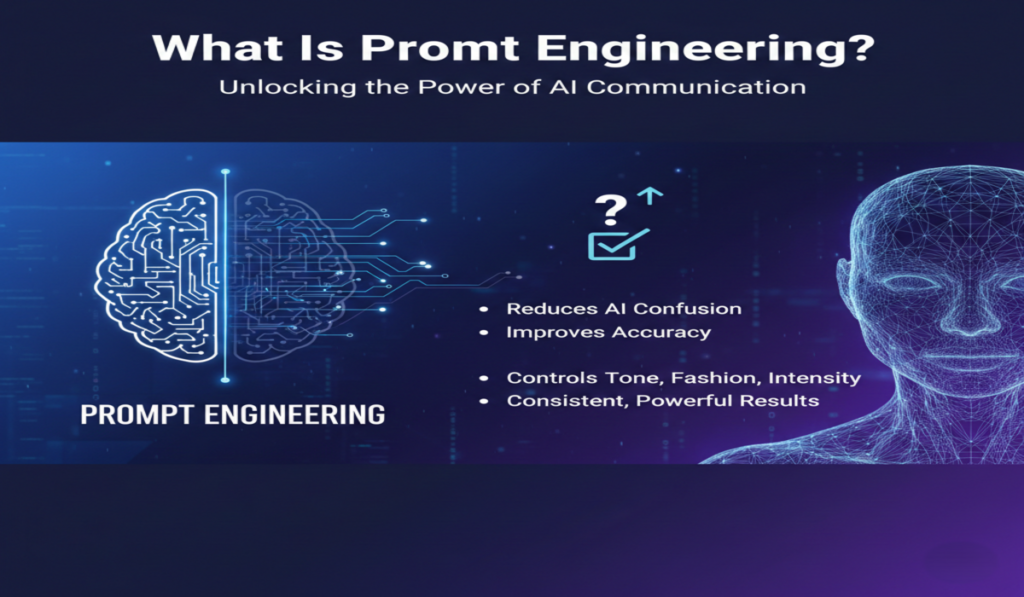
Prompt engineering means designing your input (spark off) in a way that:
- Reduces confusion for AI
- Improves accuracy
- Controls tone, fashion, and intensity
- Produces constant, tremendous results
In easy phrases:
👉 Better prompts = higher solutions
The Advanced Prompt Engineering Guide (2026 Edition) makes a speciality of how to speak to AI, no longer just what to ask.
Why Basic Prompts Fail in 2026
A fundamental spark off looks like this:
“Write a blog on AI.”
This fails because:
- No audience described
- No tone exact
- No shape
- No aim
Advanced prompt engineering fixes this by way of adding context, function, venture, and constraints.
Core Principle of Advanced Prompt Engineering
Before diving into frameworks, bear in mind this golden rule:
AI performs nice when it knows who it is, what to do, for whom, and how.
Every concept in this Advanced Prompt Engineering Guide (2026 Edition) revolves around this idea.
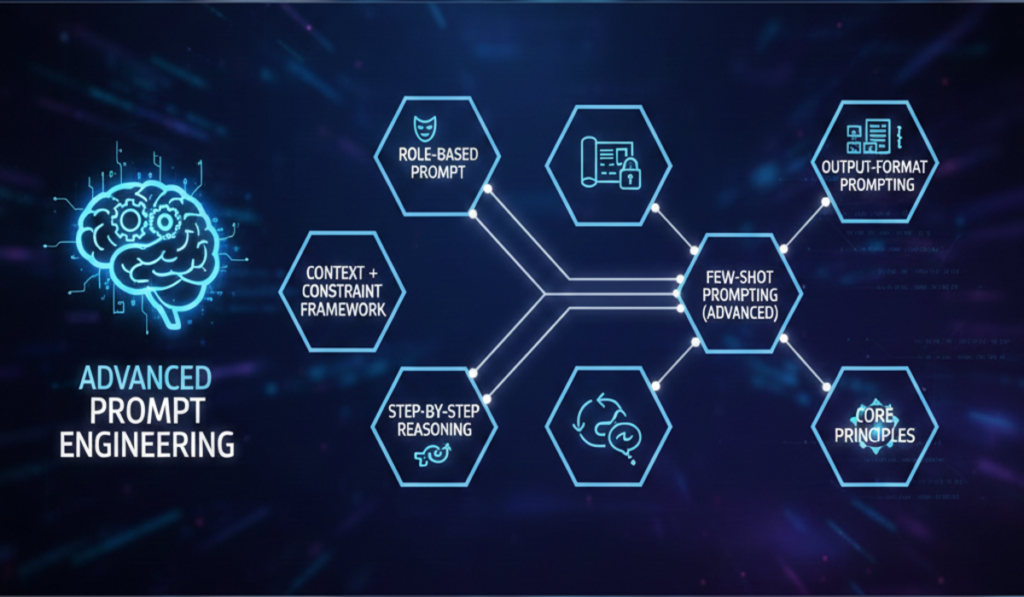
Prompt Framework #1: Role-Based Prompting (Most Powerful)
What It Is
You assign ChatGPT a specific role.
Why It Works
AI responds differently primarily based on identification.
Structure
Role + Task + Context + Output style
Example
“You are an experienced search engine marketing content material strategist. Write a newbie-friendly explanation of activate engineering in a human tone.”
This is a foundational approach in the Advanced Prompt Engineering Guide (2026 Edition).
Prompt Framework #2: Context + Constraint Framework
What It Is
You outline the situation and boundaries.
Why It Works
Constraints enhance consciousness and relevance.
Structure
Context + Task + Rules
Example
“Explain advanced activate engineering for non-technical customers. Keep language simple. Avoid jargon. Limit to three hundred words.”
This framework is extensively utilized by professionals in 2026.
Prompt Framework #3: Step-by-Step Reasoning Prompt
What It Is
You ask AI to suppose in steps.
Why It Works
Reduces mistakes and improves logic.
Example
“Explain how prompt engineering works. Break the solution into clean step-via-step factors with examples.”
This method is vital inside the Advanced Prompt Engineering Guide (2026 Edition), mainly for tutorials and causes.
Prompt Framework #4: Output-Format Prompting
What It Is
You define how the solution have to look.
Why It Works
Removes ambiguity.
Example
“Explain prompt engineering in a table with columns: Purpose, Example, Use Case.”
This is extraordinarily beneficial for blogs, reviews, and presentations.
Prompt Framework #5: Few-Shot Prompting (Advanced Level)
What It Is
You provide AI examples of desired output.
Why It Works
AI learns your sample instantly.
Example
“Here are two examples of sturdy activates. Now create three similar prompts for beginners.”
Few-shot prompting is a center pillar of the Advanced Prompt Engineering Guide (2026 Edition).
Real-World Examples of Advanced Prompt Engineering
Example 1: Blogging
❌ “Write a blog on SEO.”
✅ “You are an SEO expert. Write a 1500-word amateur weblog on SEO in a pleasant tone. Include examples and commonplace mistakes.”
Example 2: Freelancing
❌ “Write a proposal.”
✅ “You are a freelance content writer. Write a professional Upwork notion for a blog writing task. Keep it underneath 2 hundred words.”
Example 3: Learning
❌ “Explain AI.”
✅ “Explain AI to a 12-year-old the use of easy examples and brief sentences.”
Each of those reflects concepts taught inside the Advanced Prompt Engineering Guide (2026 Edition).
Prompt Chaining: The Pro Technique
Instead of 1 big activate, use a couple of linked prompts.
Example Workflow
- Generate outline
- Improve outline
- Write segment by section
- Edit tone
Prompt chaining gives better control and better fine, a key insight from the Advanced Prompt Engineering Guide (2026 Edition).
Common Mistakes in Prompt Engineering
Avoid those:
- Vague prompts
- No context
- Too many duties in one spark off
- Expecting perfection in one attempt
- Not refining responses
Prompt engineering is an iterative ability, no longer a one-time command.
Advanced Prompting Tips for 2026
- Always define audience
- Control tone explicitly
- Limit output length
- Ask for clarification if needed
- Refine in preference to restarting
These behavior separate beginners from professionals.
Who Should Learn Advanced Prompt Engineering?
This Advanced Prompt Engineering Guide (2026 Edition) is best for:
- Bloggers
- Freelancers
- Marketers
- Students
- Business owners
- AI fanatics
If you operate ChatGPT frequently, this skill multiplies your productivity.
The Future of Prompt Engineering
In the destiny:
- AI tools will improve
- Prompting will become a center digital ability
- Quality prompts will outperform raw AI strength
Those who master the Advanced Prompt Engineering Guide (2026 Edition) early will continually live ahead.
Final Thoughts
Prompt engineering is not approximately controlling AI.
It’s approximately communicating absolutely.
When you discover ways to provide clear commands, dependent context, and practical constraints, ChatGPT becomes fairly effective.
The Advanced Prompt Engineering Guide (2026 Edition) isn’t just a skill — it’s a attitude that helps you work smarter, faster, and greater accurately inside the AI era.
👉 Day 9 will consciousness on 100+ Role-Based Prompts for ChatGPT (2026 Edition)
FAQs about Advanced Prompt Engineering Guide (2026 Edition)
1. What is advanced prompt engineering?
Advanced prompt engineering is the practice of creating structured AI instructions using context, goals, constraints, examples, and specific output requirements.
2. Why is prompt engineering important in 2026?
It helps users communicate their goals more clearly with AI and can produce more relevant, consistent, and useful responses.
3. What are the main elements of a good prompt?
A strong prompt commonly includes the task, context, desired outcome, constraints, and preferred output format.
4. What is a prompt engineering framework?
A framework is a repeatable structure for writing prompts so you can consistently provide AI with the information it needs.
5. What is few-shot prompting?
Few-shot prompting gives an AI model a small number of examples to demonstrate the type of response or pattern you want.
6. Can prompt engineering improve ChatGPT responses?
Yes. Clear context, specific instructions, examples, and output requirements can make responses more relevant and useful.
7. What is iterative prompting?
Iterative prompting means improving your instructions based on the AI’s previous response instead of expecting the first prompt to produce the final result.
8. Can prompt engineering be used for SEO?
Yes. It can assist with content outlines, search-intent analysis, keyword ideas, FAQs, content briefs, and SEO workflows.
9. Is prompt engineering only useful for programmers?
No. Writers, marketers, students, researchers, designers, business owners, and other professionals can use prompt engineering.
10. What is the best prompt engineering technique?
There is no single best technique for every task. The most effective approach depends on the goal, context, AI model, and type of output required.

Suraj Verma is the Founder of AiProInsight and an AI Automation Researcher specializing in Artificial Intelligence, AI Automation, n8n, SEO, and Digital Marketing. He has published 300+ practical articles covering AI tools, automation workflows, and productivity solutions.
5 thoughts on “Advanced Prompt Engineering Guide 2026: Frameworks, Examples & Pro Techniques”