
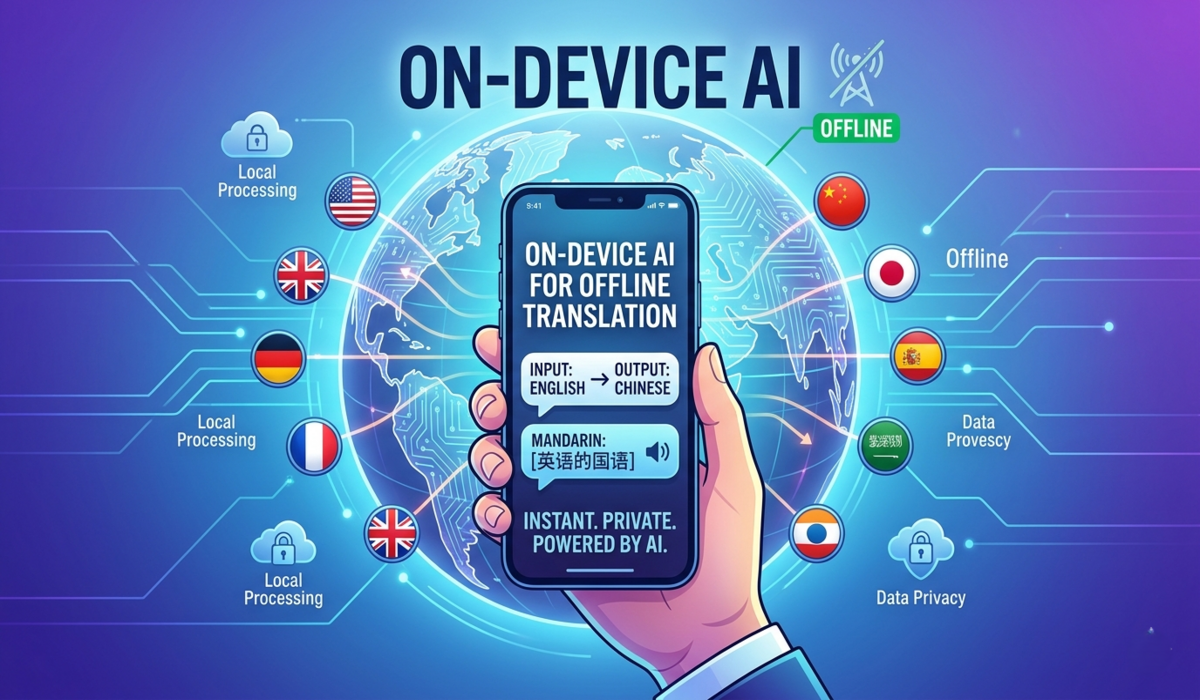
Discover how On Device AI for Offline Translation Tools is transforming communication by offering fast, private, and internet-free translations for global users.
Table of Contents
On Device AI for Offline Translation Tools – The Future of Seamless Language Communication
In today’s hyper-connected world, communication has become easier than ever—but it still breaks down when internet access disappears.

Imagine traveling in a remote area, facing poor network connectivity, or needing instant translation without sharing your data online. This is exactly where On Device AI for Offline Translation Tools – The Future of Seamless Language Communication is transforming the way we interact across languages.
Modern tools powered by on-device AI can now translate speech, text, and even images instantly—without relying on cloud servers. Popular apps like Google Translate and Microsoft Translator are already integrating offline AI capabilities to deliver faster, more secure, and highly reliable translations.
Unlike traditional cloud-based systems, on-device AI processes everything locally on your smartphone or device. This not only improves speed but also enhances privacy, making it ideal for sensitive conversations and real-time communication.
As AI models become more efficient and lightweight in 2026, offline translation tools are evolving into powerful companions for travelers, professionals, and everyday users.
In this blog, we’ll explore how On Device AI for Offline Translation Tools works, its key benefits, real-world use cases, challenges, and what the future holds for this rapidly advancing technology.
What is On Device AI for Offline Translation Tools?
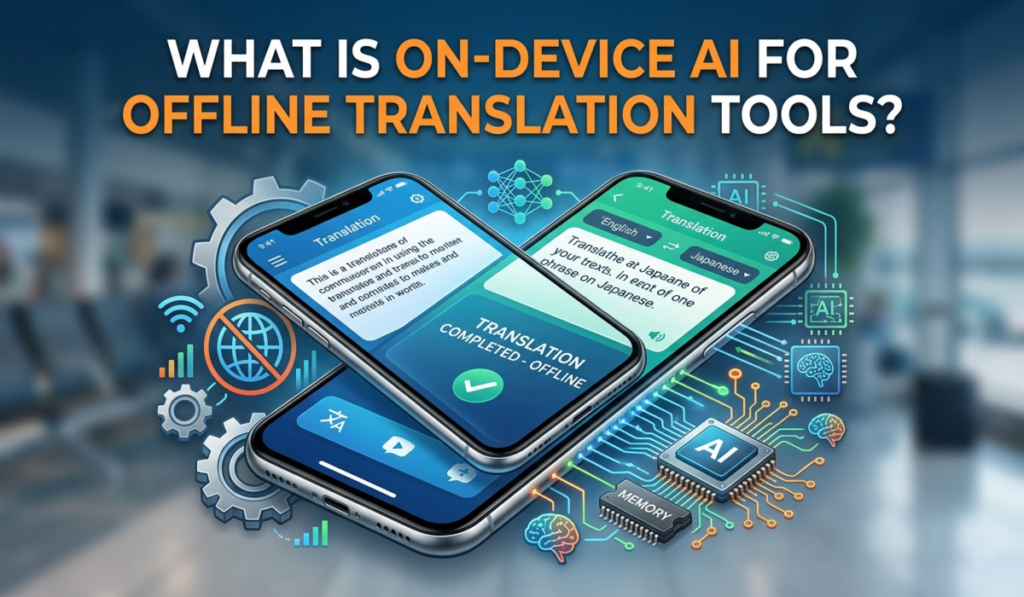
On Device AI for Offline Translation Tools refers to translation applications or devices that use artificial intelligence models stored directly on your smartphone, tablet, or dedicated translation device. Instead of sending your text or speech to a server for processing, the AI runs locally.
This means you can:
- Translate without internet or mobile data.
- Get instant responses without delays caused by network latency.
- Maintain higher privacy because your data never leaves your device.
How Does On-Device AI for Offline Translation Work?
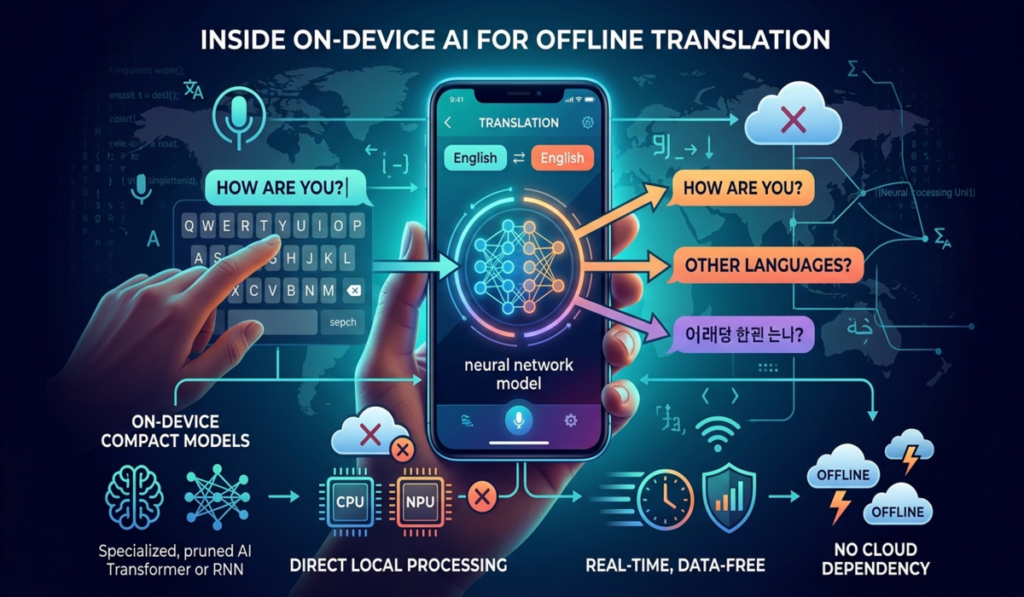
The magic lies in advanced AI models—specifically, neural machine translation (NMT) models—that have been trained on massive datasets. These models are compressed and optimized so they can run on mobile devices without consuming too much storage or battery.
The process is simple:
- Input – You speak or type in your language.
- Local Processing – The AI model on your device processes the input.
- Output – It instantly provides the translation in the target language.
No internet required. No data sent to the cloud.
Why is On Device AI for Offline Translation Tools Important?
There are several reasons why this technology is becoming essential:
- Accessibility in Remote Areas – Travelers or aid workers in rural locations can still communicate effectively.
- Privacy Protection – Sensitive conversations remain on your device.
- Instant Response – Eliminates waiting time caused by slow internet.
- Cost-Effective – No need to spend on roaming data or expensive Wi-Fi.
- Inclusivity – Helps people with limited internet access engage in global conversations.
Real-Life Use Cases

1. Travel and Tourism
Imagine visiting Japan and needing help ordering food. With On Device AI for Offline Translation Tools, you can simply speak into your phone and get an accurate Japanese translation instantly—without worrying about finding Wi-Fi.
2. Emergency Situations
First responders in disaster-hit areas can communicate with locals even if internet networks are down.
3. Business Meetings
Global teams can hold meetings without relying on online translation services, ensuring data security.
4. Education
Students can translate study material from foreign languages without needing the internet.
Key Advantages Over Online Translation Tools
While online tools are powerful, On Device AI for Offline Translation Tools offer:
- Faster translations (no server delays).
- Better privacy (data stays on device).
- No dependency on network stability.
- Lower cost (no data charges).
Technologies Powering On-Device AI
To make On Device AI for Offline Translation Tools possible, several innovations are used:
- Model Compression – Large AI models are shrunk using quantization and pruning.
- Edge AI Chips – Mobile processors with AI accelerators improve speed and efficiency.
- Efficient Neural Networks – Optimized algorithms ensure high accuracy even offline.
- Multilingual Datasets – AI is trained on millions of sentence pairs to understand language nuances.
Popular Tools and Devices
Some examples of On Device AI for Offline Translation Tools consist of:
- Google Translate (Offline Mode) – Supports dozens of languages offline.
- Microsoft Translator – Offers offline language packs.
- ITranslate – Works with out net after downloading language files.
- Pocketalk – Dedicated translation device with offline features.
Challenges of On Device AI for Offline Translation Tools
While the era is impressive, it nevertheless faces hurdles:
- Storage Limitations – Language models take in area.
- Accuracy for Complex Phrases – Offline models can be less accurate than cloud-primarily based ones.
- Updating Models – Requires occasional internet connection for updates.
The Future of On-Device AI for Offline Translation
The future is bright for On Device AI for Offline Translation Tools. With advancements in edge AI chips, model compression, and better multilingual training, we can expect:
- Real-time voice-to-voice translations with near-human accuracy.
- Multi-modal translation (text, voice, images combined).
- Smaller, more efficient models that can fit on any device.
- Integration with wearables like AR glasses for instant translation in your field of view.
Tips to Choose the Right On-Device AI Translation Tool
When picking your translation tool, consider:
- Number of Offline Languages Supported.
- Translation Accuracy.
- Speed of Response.
- Storage Space Required.
- Privacy Policy.
Conclusion
On Device AI for Offline Translation Tools are breaking down language barriers, making verbal exchange faster, safer, and extra on hand—even with out the net. Whether you’re a tourist, student, or expert, having this type of gear to your pocket can make a world of difference.
As generation evolves, we’ll see even greater accurate, compact, and versatile offline translation options—supporting us hook up with people everywhere, each time.
FAQs
1. What is On Device AI for Offline Translation Tools?
On-Device AI for Offline Translation Tools refers to AI models that run directly on a device (like a smartphone) to translate languages without requiring an internet connection.
2. How does offline translation work without the internet?
Offline translation works by using pre-downloaded AI language models stored on your device. These models process text, voice, or images locally to provide instant translations.
3. Which apps support on-device AI translation?
Popular apps like Google Translate and Microsoft Translator support offline translation features using on-device AI technology.
4. What are the benefits of on-device AI translation?
Key benefits include:
- Works without internet
- Faster response time
- Enhanced privacy (no cloud data sharing)
- Reliable in remote areas
- Real-time communication support
5. Is offline translation as accurate as online translation?
Offline translation has improved significantly in 2026, but in some complex cases, cloud-based translation may still offer slightly higher accuracy due to larger models.
6. Who can benefit from offline translation tools?
Travelers, business professionals, students, healthcare workers, and anyone working in low-connectivity areas can benefit from on-device AI translation tools.
7. What is the future of on-device AI in translation?
The future includes more accurate real-time translations, support for more languages, better voice recognition, and deeper integration into smartphones and wearable devices.
4 thoughts on “On Device AI for Offline Translation Tools – The Future of Fast, Private & Internet-Free Language Communication 2026”