
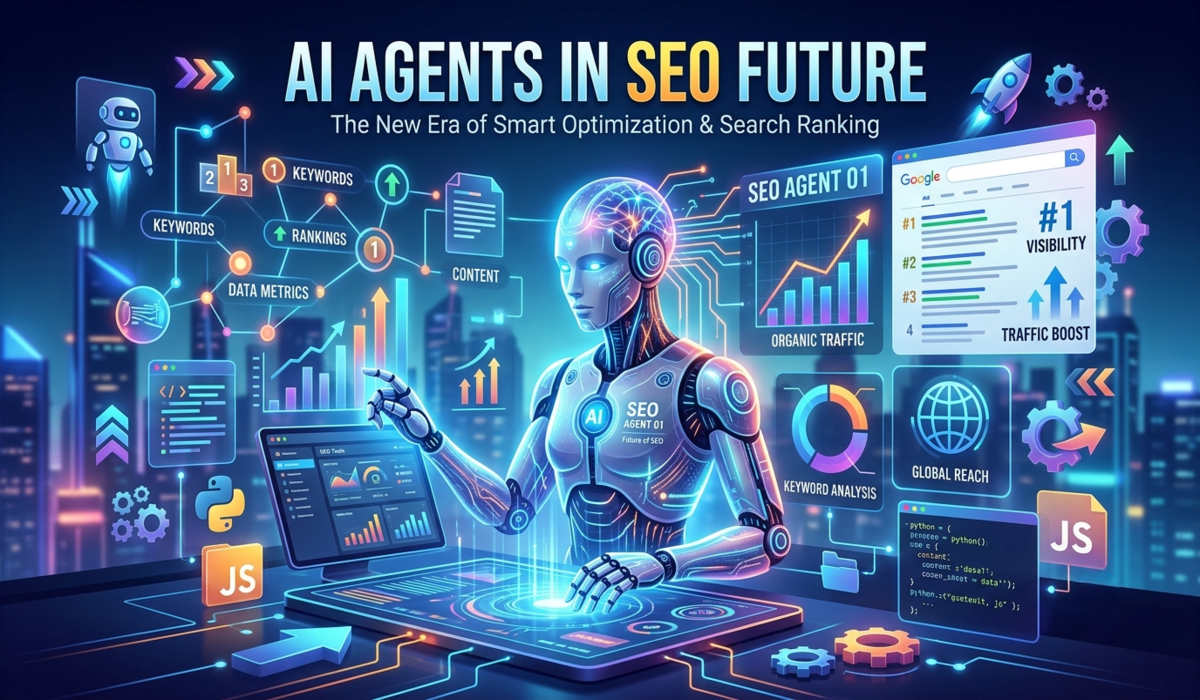
Discover the role of AI agents in SEO future and learn how autonomous intelligence will reshape search, content discovery and rankings for businesses.
Table of Contents
AI Agents in SEO Future : The Next Frontier of Search
The SEO industry is entering a new era powered by autonomous artificial intelligence.
In 2026, search engine optimization is no longer limited to manual keyword research, content creation, technical audits, and backlink building. A new generation of intelligent systems known as AI Agents is transforming how SEO strategies are planned, executed, monitored, and optimized.
This shift has made AI Agents in SEO one of the most important topics for marketers, agencies, bloggers, and businesses looking to stay competitive in the AI-first search landscape.
Unlike traditional AI tools that require constant human input, AI agents can:
- Analyze search trends
- Conduct keyword research
- Create content strategies
- Monitor rankings
- Optimize technical SEO
- Identify opportunities
- Automate repetitive tasks
- Adapt strategies based on performance data
Modern AI platforms such as ChatGPT, Google Gemini, and other advanced AI ecosystems are accelerating the development of autonomous SEO workflows.
At the same time, search engines are becoming more intelligent, relying on:
- AI-powered ranking systems
- User intent analysis
- Semantic search understanding
- Conversational search experiences
- Voice search optimization
- Real-time content evaluation
In 2026, AI agents can help businesses:
- Scale SEO operations faster
- Improve content quality
- Reduce manual workload
- Discover ranking opportunities
- Optimize websites continuously
- Make data-driven decisions in real time
However, AI agents are not replacing SEO professionals. Instead, they are becoming powerful assistants that allow marketers to focus on strategy, creativity, and business growth while automation handles routine tasks.
As AI-generated search experiences, answer engines, and conversational platforms continue expanding, businesses that embrace AI-driven SEO workflows will gain a significant competitive advantage.
The future of SEO will likely involve collaboration between human expertise and autonomous AI systems working together to deliver better content, improved user experiences, and stronger search visibility.
In this blog, we’ll explore how AI Agents in SEO work in 2026, why they are transforming digital marketing, and the strategies businesses can use to prepare for the next generation of AI-powered search optimization.
What Are AI Agents in SEO Future ?
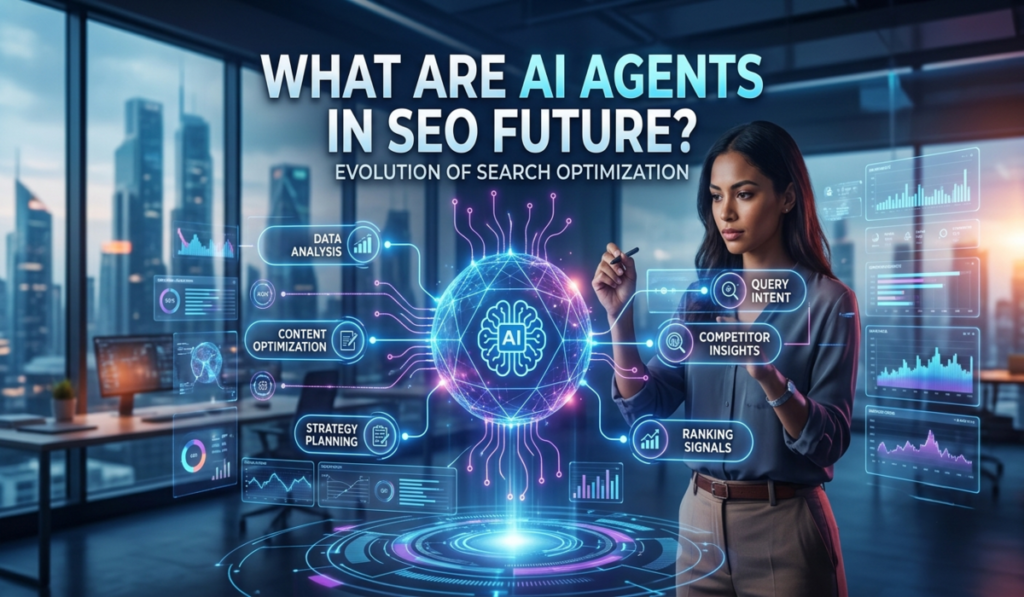
At its center, the phrase AI agents in SEO future refers to smart, goal-driven applications that perform SEO workflows: from keyword research, content material technology, linking strategies, to monitoring and adapting performance. Unlike conventional gear that require human guidance at each step, AI agents can determine, act and analyze—tailor-made to search engine marketing objectives.
Sources display that by 2026, such agentic structures turns into mainstream in seek and content material workflows.
For search engine marketing professionals, this indicates transferring from handling duties to supervising marketers.
Why AI Agents in SEO Future Matter
Here are numerous compelling motives why you ought to pay attention to AI Agents in SEO Future :
- Automation at scale – Tasks that when required hours of manual work can be treated autonomously. AI retailers will lessen time to optimize and allow more rapid generation.
- Search is shifting – Search interfaces are moving in the direction of conversational AI, answer engines and agent-pushed discovery layers, instead of traditional keyword search effects.
- New aggressive advantage – Brands that undertake agentic search engine marketing early will unlock performance benefits, being visible in the “agent layer” of search.
- Complex workflows simplified – Content strategy, hyperlink acquisition, semantic optimization, and inner linking can be orchestrated by means of AI agents, releasing people to recognition on creativity and oversight.
- Better insights and adaptation – AI agents can continuously screen overall performance alerts, hit upon possibilities or threats, and adapt your SEO strategy in actual-time.
How AI Agents in SEO Future Works
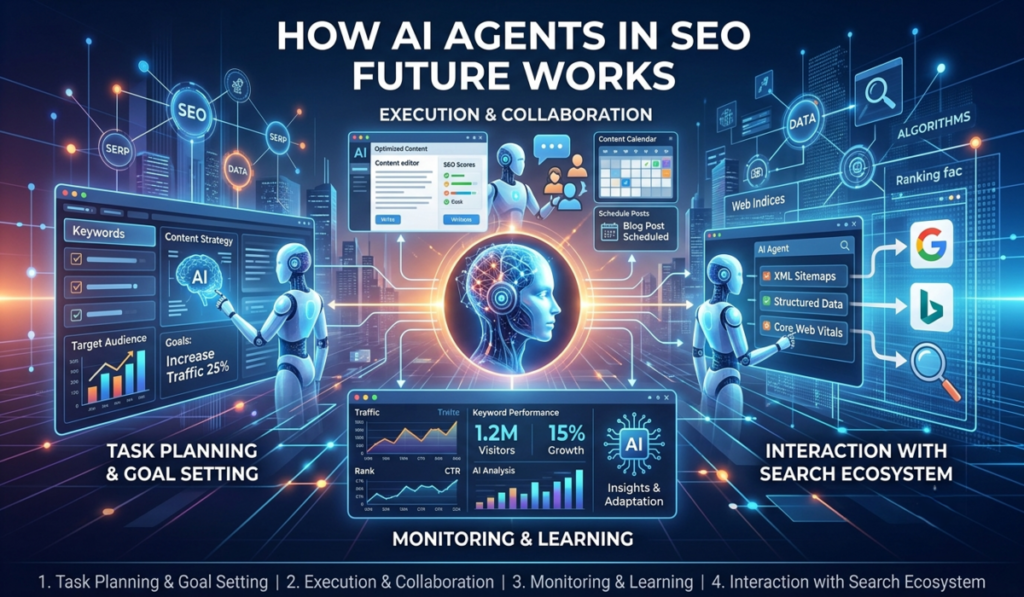
Let’s smash down how AI agents in SEO future will function in practice.
1. Task Planning and Goal Setting
An search engine optimization agent starts offevolved with objectives such as “Increase organic visibility for topic cluster X via 40% in 6 months.” It then defines tasks: keyword discovery, content creation, hyperlink outreach, optimization.
2. Execution and Collaboration
Agents execute obligations:
- Discovery agent reveals keywords and content material gaps.
- Content agent drafts articles, optimizes headings, meta descriptions.
- Technical agent scans web page performance, center net vitals, schema markup.
- Outreach agent identifies link opportunities, drafts outreach templates.
This department of labor aligns with the idea of AI agents in SEO future operating as teams.
3. Monitoring and Learning
Agents examine metrics: SERP shifts, click-via prices, voice search signals, AI solution engine citations. Based on comments, they alter approaches — e.G., modify content cluster, replace inner hyperlinks, refresh metadata.
4. Interaction with Search Ecosystem
In 2026, users may additionally engage via AI assistants or agent layer instead of traditional seek bars. Your content material desires to be readable and digestible by means of other AI agents, now not simply humans.
Key Components You Must Address
To include AI agents in SEO future , your approach should cover those foundational elements:
- Structured content and schema: Agents select content material that’s nicely-organized, tagged, and clean to parse.
- Semantic clusters and subject matter authority: Instead of random pages, construct complete clusters reflecting user intent and context.
- Technical excellence: Fast loading, reachable APIs, proper statistics-drift signals count to downstream marketers and seek structures.
- Agent-friendly workflows: Think about how an agent might devour your web site — clean headings, FAQs, metadata, inner linking, hyperlink signals.
- Visibility in AI answer layers: Recognition isn’t handiest about rating pages; it’s approximately being noted by means of AI dealers inner answer engines and chat interfaces.
Practical Steps to Prepare for AI Agents in SEO Future
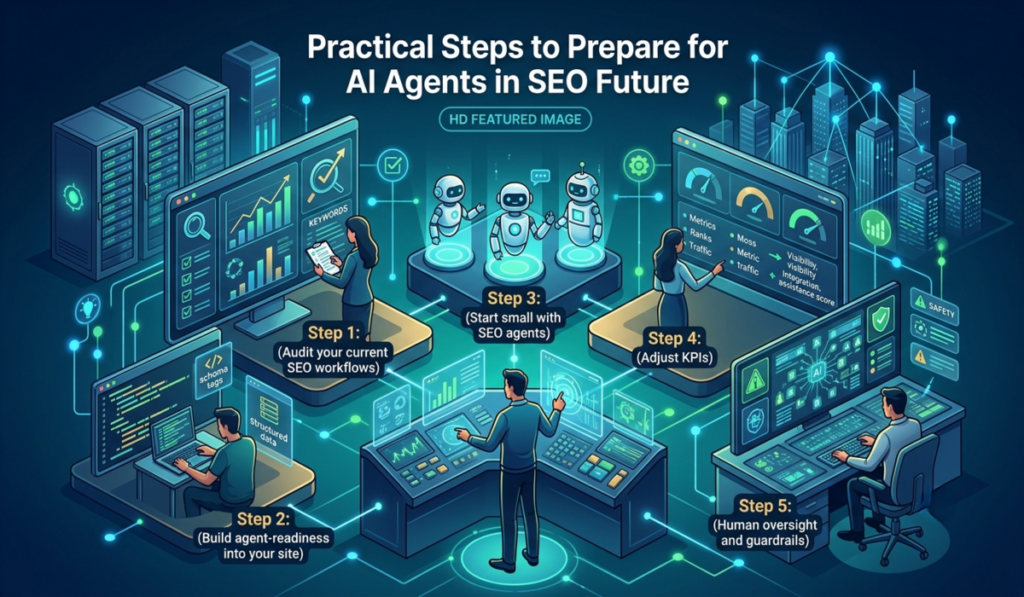
Step 1: Audit your current SEO workflows
Identify repetitive responsibilities, guide interventions, and dependencies. Ask: which responsibilities may want to an agent cope with nowadays?
Step 2: Build agent-readiness into your site
- Enhance schema markup for articles, FAQs, products.
- Create topic clusters with herbal language queries.
- Write content with query and solution style — pleasant for marketers and for voice/agent queries.
- Improve web site performance and API accessibility.
Step 3: Start small with SEO agents
Use tools/plugins that automate components of your workflow (key-word studies, inner linking, meta updates). As you trust them, expand to greater complicated workflows.
Step 4: Adjust KPIs
Traditional KPIs (page rank, one-way links) will nonetheless remember, but add new ones applicable to agent-visability: citations in AI answer engines, voice/agent visitors, brand mentions in agent layers.
Step 5: Human oversight and guardrails
Even even though agents execute responsibilities, humans set approach, approve fundamental actions and maintain brand voice. Over-automation without oversight leads to mistakes.
Benefits of Embracing AI Agents in SEO Future
When carried out successfully, right here are the key advantages of adopting AI agents in SEO future :
- Faster time to insight and movement.
- Enhanced scalability: control extra topics, languages, regions.
- Competitive area: early adoption yields long-term lead.
- Greater flexibility: adapt faster in a search ecosystem that adjustments quick.
- Reduced dependency on guide labour for repetitive SEO responsibilities.
Potential Risks and How to Mitigate
Although the promise is huge, there are risks in embracing AI agents in SEO future :
- Over-automation: Agents doing everything without human test can produce low-fine or mis-aligned content material.
- Transparency issues: Agents might also use statistics or indicators which you don’t completely manipulate or apprehend.
- Dependence on platforms: If dealers perform inner proprietary ecosystems, you could lose manage.
- Ethical/brand risks: Mis-guided agent actions can undermine logo voice or credibility.
Mitigation: maintain human governance, frequently audit agent outputs, set clear guardrails and emblem guidelines.
Real-World Scenario
Imagine a content-rich brand running more than one blogs across areas and languages. Instead of manually coordinating each article, an included AI agent machine (discovery, content, outreach, monitoring dealers) executes the workflow. Over six months, this brand lifts visitors by 50 % even as reducing guide work hours with the aid of -thirds. This is the promise of AI agents in SEO future .
The Future Looking Forward
By 2026, we’ll see:
- Search interfaces driven via retailers as opposed to typed queries.
- Brands being determined now not thru rating pages however thru citations in agentic solutions.
- Autonomous search engine optimization marketers interacting across structures, updating content, fetching new indicators, optimizing in actual-time.
- Search engine optimization turning into more about visibility to agents and less approximately visibility to users.
Those who do now not adapt to AI agents in SEO future chance falling in the back of in an ecosystem where visibility = being accessible to dealers.
Conclusion
We are coming into a new generation. The phrase AI agents in SEO future isn’t just jargon—it’s a fundamental shift. Search engine optimization will now not just be approximately hyperlinks and key phrases; it’ll be about how your content material interacts with self sustaining sellers, how seen your emblem is to them, and the way speedy you adapt.
Start now. Audit your approaches. Optimize for agent-readiness. Integrate established information. And importantly, hold the human contact. Because even when agents take over obligations, people still form method.
The manufacturers that position themselves as agent-friendly will lead the pack In 2026 and beyond.
FAQs
1. What are AI agents in SEO?
AI agents are autonomous AI systems that can perform, manage, and optimize SEO tasks with minimal human intervention.
2. How are AI agents different from traditional SEO tools?
Traditional tools provide recommendations, while AI agents can analyze data, make decisions, and execute optimization tasks automatically.
3. What SEO tasks can AI agents perform?
AI agents can help with:
- Keyword research
- Content planning
- Technical SEO audits
- Rank tracking
- Competitor analysis
- Content optimization
- Performance monitoring
4. Will AI agents replace SEO professionals?
No. AI agents are designed to assist SEO professionals by automating repetitive tasks while humans focus on strategy and creativity.
5. How can businesses benefit from AI-powered SEO automation?
Benefits include:
- Faster workflows
- Better scalability
- Improved efficiency
- Data-driven decision making
- Continuous optimization
6. Which AI platforms are influencing the future of SEO?
Platforms such as ChatGPT and Google Gemini are helping shape the future of AI-powered search and content optimization.
7. What is the future of AI agents in SEO?
The future includes autonomous SEO workflows, predictive optimization, AI-driven content strategies, real-time search adaptation, and deeper integration with conversational and answer-engine search platforms.
5 thoughts on “AI Agents in SEO: How Autonomous Intelligence Will Redefine Search”